
聖基茨和尼維斯投資公民部的主管 Mr. Les Khan 於一個近日的訪問中確認了現時的颶風基金捐款選擇將於原定的2018年3月31日完結,不會延續。 此計劃停止後捐款選擇金額必定回升,唯有機會比之前的定額為低,最終的額度將於近日公佈。
Tag Archives: 公民計劃


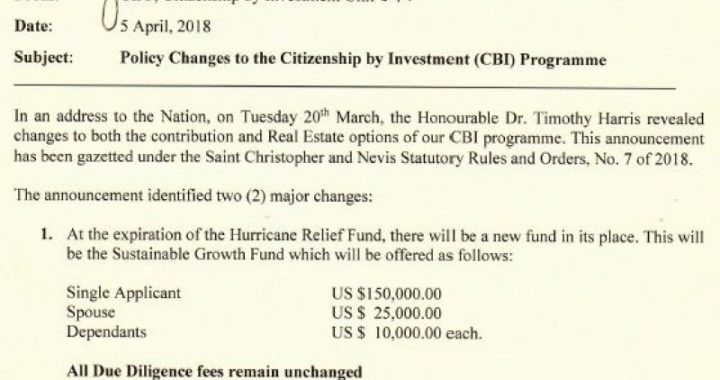
聖基茨政府已把投資公民申請的捐款及房產選項金額調整,各項變更的費用詳情如下,即日生效
聖基茨政府已把投資公民申請的捐款及房產選項金額調整,各項變更的費用詳情如下,即日生效:
捐款選項
- 主申請人US$150,000;
- 配偶US$25,000;
- 其餘每位受養人 (不論年齡 – 即包括30歲或以下的未婚受養子女及55歲或以上的受養父母和祖父母) US$10,000。
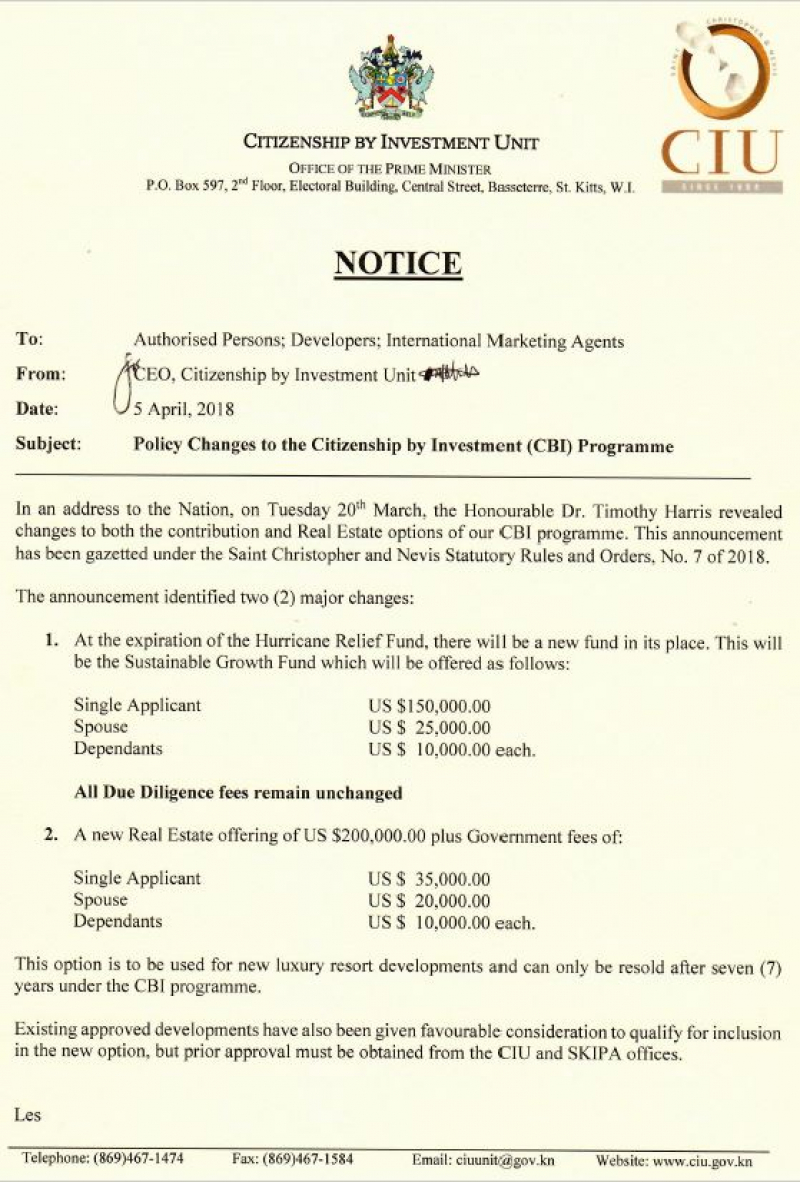
房產選項
新增一項US$200,000的投資金額選擇,但房產在7年後才可出售。
原本的US$400,000的投資金額選擇依舊存在,房產可在5年後出售。


The More CIP Countries, the Better For the Industry, Says Mohammed Asaria in Interview
Source: Investment Migration Insider
https://www.imidaily.com/caribbean/cip-countries-better-industry-says-mohammed-asaria-interview/
Author: Christian Henrik Nesheim
Vice Chairman of Range Developments, Mohammed Asaria, tells Investment Migration Insider in an interview that the introduction of more countries to the citizenship by investment market will keep countries “on their toes” and compel them to refine their product.
Range Developments is the firm behind the winner of Caribbean Travel Awards’ “Best New Hotel in the Caribbean” Prize, the Saint Kitts Park Hyatt, and is also developing the Cabrits Resort by Kempinski in Dominica (about halfway completed) as well as the Black Bay Resort by Ritz Carlton, scheduled for completion in 2021.

Citizenship by Investment Caribbean / Dominica Real Estate
Citizenship by Investment Caribbean / Dominica Real Estate

REAL ESTATE
To qualify for citizenship of Dominica under the Real Estate Option of the Citizenship by Investment Programme, an applicant must purchase authorized real estate to the minimum value of USD 200,000.
On approval in principle of an application through a real estate investment or other approved project, the following fees also apply:
- USD 25,000 for the Main Applicant;
- USD 35,000 for the Main Applicant applying with his or her spouse;
- USD 35,000 for a family of up to four persons, including the Main Applicant and up to three dependants
- USD 50,000 for a family of up to six persons, including the Main Applicant and up to five dependants; or
- USD 70,000 for a family of seven persons or more, including the Main Applicant and six or more dependants
For a full breakdown of the other fees payable under the Real Estate Option, including due diligence fees
The real estate must be held for 3 years and may be eligible for re-sale under the Citizenship by Investment Programme after 5 years from the grant of citizenship.
Link : http://cbiu.gov.dm/investment-opportunities/real-estate/
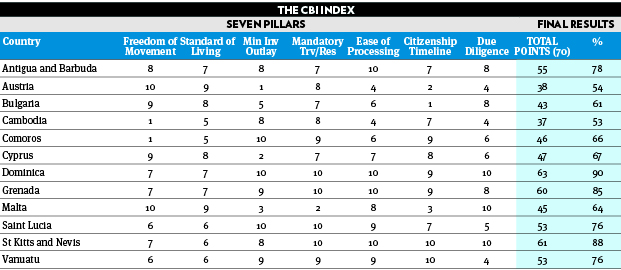
The CBI Index: key findings – Caribbean programmes out in front
The CBI Index: key findings – Caribbean programmes out in front
BY CBI INDEX RESEARCH TEAM
The CBI Index’s key findings allow readers to either perform an overall review of the programmes, or evaluate the pillars individually
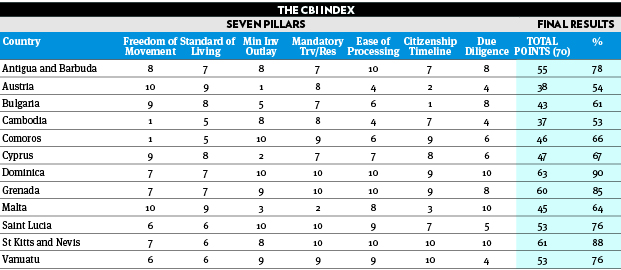
In providing both programme rankings and rankings by each of the seven pillars, the CBI Index affords readers the opportunity to either perform an overall review of the programmes, or complete a critical appraisal of the pillar that is of greatest consequence to them.
The following key findings emerge from the CBI Index rankings:
Pillar 1: Freedom of Movement
The countries that scored the highest in freedom of movement were the four European nations included in the CBI Index: Austria, Malta, Cyprus, and Bulgaria. Of these four, the highest-ranking were also members of the Schengen Area, which, for the most part, operates under a common visa policy.
FURTHER READING
A guide to global citizenship
The Caribbean followed Europe, having access to numerous key financial centres and having worked extensively to forge closer ties with other nations and to increase the number of destinations to which their citizens can travel visa-free. Antigua and Barbuda scored slightly higher than the other Caribbean islands.
Vanuatu ranked third-to-last, but significantly above Cambodia and Comoros, which received the lowest possible score under this section. Cambodia and Comoros received low scores both because of their poor overall ability to offer citizens visa-free travel, and because they lack the adequate travel treaties to ensure their citizens can easily access today’s prime business centres.
Pillar 2: Standard of Living
Standard of living saw Europe receive the highest scores, with Austria and Malta both topping the rankings. Austria obtained the best results in all sub-indicators with the exception of real GDP growth, where, together with Dominica and Saint Lucia, it was awarded the lowest mark. It is worth noting that Dominica’s GDP was affected by the horrific Storm Erika, which set back the country’s economic growth for 2016. It is no surprise that there are staggering growth rates seen from emerging markets such as Cambodia and Vanuatu.
The life expectancy sub-indicator revealed that, but for Austria, the longest lives can be enjoyed on the Mediterranean Sea. Close behind in second was Dominica – a lush island known for its abundant nature, spiritual atmosphere, and reliance on clean energy sources.
Expected years of schooling, another sub-indicator for a country’s standard of living, saw Austria and Grenada obtain the top scores. Living in a country with more than 30 public and private universities, it should come as no shock that young Austrian men and women remain in education for long periods of time. Less well-known is Grenada’s devotion to education, which has also led to it receiving international praise for its St George’s University – a leading medical and veterinary school.
Overall for this pillar, Antigua and Barbuda, Dominica, and Grenada placed best out of the Caribbean – a region that, on the whole, ranked just below Europe. Island-nation Vanuatu equalled Saint Lucia and St Kitts and Nevis, while Cambodia and Comoros received the lowest scores. Comoros was especially penalised by its results in sub-indicators such as life expectancy and gross national income (GNI). Cambodia was listed as the nation least dedicated to the freedom of its people, shedding light on its inability to uphold political and civil rights.
Perhaps unexpectedly, Cambodia was among the highest-ranking nations under the relative safety sub-indicator, which measures intentional homicide rates. The country scored the same as Europe and Vanuatu, the latter of which is known to be one of the least dangerous destinations in Oceania.
Pillar 3: Minimum Investment Outlay
Offering the most affordable option for second citizenship, Comoros received its highest ranking in this pillar – which also saw Dominica and Saint Lucia top the list. Vanuatu and Grenada were close seconds, both offering citizenship to single applicants for less than or equal to $200,000. Austria received the lowest ranking, offering citizenship for over forty times that amount.
Cyprus and Malta both obtained low scores, themselves extending citizenship for more than $2m and $1.2m respectively. Bulgaria ranked below Antigua and Barbuda and St Kitts and Nevis, but is the most affordable programme in Europe.
Pillar 4: Mandatory Travel or Residence
Dominica, Grenada, Saint Lucia, and St Kitts and Nevis achieved full scores under this pillar, as none of them require applicants to travel to or reside within their territory at any time prior to or after receiving citizenship. Indeed, these four jurisdictions rely on their stringent due diligence procedures to obviate any need to meet the applicant in person. It is important to mention, however, that these countries are famed for being welcoming, and applicants are invited to spend time visiting the countries whenever possible.
A high score was given to Comoros and Vanuatu, whose travel requirements can be waived by the payment of an additional fee. Austria, Cambodia, Antigua and Barbuda, Bulgaria, and Cyprus also received creditable scores.
Significantly below all other countries came Malta, whose more complex physical residence requirements placed it at the bottom of the scoring scale. Malta’s ‘genuine link’ test only provides some flexibility to how an individual can demonstrate residence on the island.
Pillar 5: Citizenship Timeline
St Kitts and Nevis, the sole nation to offer both a secure and an efficient timeframe for application processing, ranked best together with Vanuatu, which promises citizenship in around one month. High marks were awarded to Comoros, Dominica, and Grenada – whose average times were slightly less than those for Cyprus, Antigua and Barbuda, Cambodia, and Saint Lucia. In normal circumstances, these seven countries all offer processing times between more than one and less than five months.
Malta and Austria each received very low scores due to their protracted processing procedures, although it was Bulgaria that scored the lowest, as citizenship of this nation can only be obtained within three to five years, depending on whether the applicant chooses the more expensive fast-track route.
Pillar 6: Ease of Processing
The Caribbean was awarded the highest number of points for its ability to offer applicants streamlined and clear procedures to apply for citizenship. This reflects two important points regarding the region. Firstly, the requirements imposed on applicants in the Caribbean each follow the same model, and secondly, these nations have all committed to making their procedures transparent.
Vanuatu attained the same result as Saint Lucia, receiving equal points for all sub-indicators. Both performed weakly when evaluated for their ability to deliver on the promise of citizenship. Saint Lucia, for example, lost points following claims that all citizenships received under the December 2016 amendments to their Citizenship by Investment Programme (which came into force on January 1, 2017) would be reviewed and may be revoked should the applicant fail to make additional disclosures, payments, and filings.
Malta and Cyprus each scored below Vanuatu and Saint Lucia, dropping in the rankings because they leave no alternative to the applicant other than the purchase or rental of real estate – property transactions that inevitably come with hefty paperwork and enhanced due diligence on the property investment. While offering real estate investment under their citizenship programmes, the jurisdictions of the Caribbean do not make the purchase or rental of real estate mandatory.
With its requirement to acquire a bond portfolio, Bulgaria also failed to rank well. Lack of support from official government sources put Comoros, Austria, and Cambodia at a strong disadvantage. Enforcement of tests, previous business experience prerequisites, and compulsory interviews also factored in these weak results.
Pillar 7: Due Diligence
Dominica, Malta, and St Kitts and Nevis scored equally to take first place, owing to their unique data collection and due diligence features. Generally, the Caribbean scored remarkably well – as did Bulgaria, thanks, among other things, to its thorough questioning of applicant information.
Comoros and Cyprus obtained average scores, while Austria, Cambodia, and Vanuatu each received the lowest scores attained under this pillar. Despite its high investment threshold, Austria falls short of many other nations with respect to the level of due diligence it performs on its applicants, especially when exploring the history and source of the applicant’s funds.
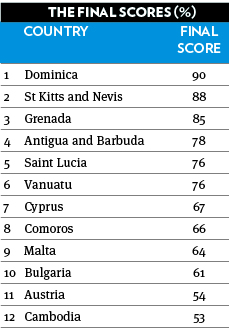
Final Scores: The Best Programmes
Considering the stability and longevity of the programmes in the Caribbean, it is no surprise that the Caribbean jurisdictions ranked in the CBI Index’s top five positions, with Dominica – home to one of the longest-running citizenship by investment programmes, and known for its speedy procedures and affordable entry thresholds – attaining the highest ranking.
This echoes current trends in the economic citizenship market, which have seen Dominica’s popularity grow in recent years. St Kitts and Nevis took second place due to its reputation for integrity and trust but scored slightly lower due to a higher investment threshold. Grenada, a relatively new programme relaunched in 2013, emerged from an unstable first year to become one of today’s most interesting citizenship by investment options, particularly following the implementation of reforms in 2015.
Antigua and Barbuda and Saint Lucia, coming fourth and fifth respectively, completed the picture of a citizenship by investment arena dominated by the Caribbean.
Vanuatu, perhaps surprisingly for a less-known programme, ranked fifth together with Saint Lucia, having obtained consistently high scores under all the pillars. Cyprus received the best score out of any European nation, distinguishing itself for its attractive travel and residence requirements. Comoros finished in eighth position, bolstered by its inexpensive investment requirements, rapid application turnarounds, and minimal travel and residence requirements – but damaged by its comparative inability to provide citizens with sufficient freedom of movement and a tolerable standard of living.
Malta, together with Austria, attained the highest scores in freedom of movement and standard of living, as well as achieved the highest score, together with Dominica and St Kitts and Nevis, for due diligence. Having received a commendable score for ease of processing, Malta was however among the lowest-scoring nations for all other pillars.
Bulgaria, the country to come 10th in the CBI Index, was especially harmed by the length of its citizenship routes and costly investment requirements. Austria is predictably one of today’s least sought-after citizenship by investment programmes: enticing applicants with the promise of life in a prosperous European nation, but offering an abstruse programme known for its expensive and lengthy procedures.
Cambodia, the lowest-ranking programme, was consistently hovering at the end of the spectrum, except in the case of investment thresholds, travel and residence requirements, and citizenship timeline.
Link: http://www.pwmnet.com/Financial-Centres/The-CBI-Index-key-findings-Caribbean-programmes-out-in-front#pluck-comment-tabs

Citizenship Bill Receives Royal Assent
Citizenship Bill Receives Royal Assent
News Release
From Immigration, Refugees and Citizenship Canada
June 19, 2017 – Ottawa, ON – Today, Bill C-6, an Act to amend the Citizenship Act and make consequential amendments to another Act, received Royal Assent.
Changes to the Citizenship Act reflect the Government’s commitments to streamline the citizenship process, enhance program integrity, and repeal certain provisions of the Act that treated dual citizens differently than other Canadians. Some changes to the Citizenship Act take effect immediately upon Royal Assent, while others take effect at later dates to ensure the necessary regulatory changes and departmental preparations are in place for a smooth transition for applicants.
As of today, applicants are no longer required to intend to continue to live in Canada once granted citizenship, providing more flexibility to Canadians who may need to live outside of Canada for work or personal reasons. Immediate changes also include repealing the ability to revoke citizenship from dual citizens convicted of crimes against the national interest. Dual citizens living in Canada who are convicted of these crimes will face the Canadian justice system, like other Canadian citizens who break the law.
Some of the changes that are expected to take effect later this fall will give more flexibility to both younger and older eligible immigrants to obtain citizenship. These changes include reducing the time permanent residents must be physically present in Canada to three out of five years, instead of four out of six years, before applying for citizenship; amending the age range for people to meet the language and knowledge requirements for citizenship from 14-64 years to 18-54 years; and counting some of the time applicants spend in Canada as temporary residents or protected persons toward their physical presence requirements for citizenship.
Other changes that are expected to take effect next year include strengthening the citizenship revocation process by having the Federal Court as the decision-maker on most cases, thereby enhancing the procedural fairness of the process. For a complete list of changes made to the Citizenship Act and when they take effect, please read the Bill C-6 Backgrounder.
Quotes
“Canada’s identity has always been shaped by the significant economic, cultural and social contributions of immigrants. Changes to the Citizenship Act will enhance program integrity, while giving more flexibility to eligible applicants to meet the requirements for citizenship so that they can continue building successful lives in Canada.”
The Honourable Ahmed Hussen, Minister of Immigration, Refugees and Citizenship
Related Products
Bill C-6 Receives Royal Assent
Backgrounder
From Immigration, Refugees and Citizenship Canada
Bill C-6, an Act to amend the Citizenship Act and make consequential amendments to another Act, received Royal Assent on June 19, 2017. This chart explains the changes that have been made to the Citizenship Act and indicates when these changes are expected to come into force, please read the Bill C-6 Backgrounder.
Link: https://www.canada.ca/en/immigration-refugees-citizenship/news/2017/06/citizenship_billreceivesroyalassent.html
Link: https://www.canada.ca/en/immigration-refugees-citizenship/news/2017/06/bill_c-6_receivesroyalassent0.html
特恩布林宣佈澳洲頒佈更嚴謹的公民法
特恩布林宣佈澳洲頒佈更嚴謹的公民法
- 更嚴謹的公民入籍試;
- 擁有家庭暴力和有組織罪行歷史不能入籍;
- 申請人要證明融入澳洲社會,例如受雇和孩子有上學;
- 更嚴格的英語測試,包括讀、寫和聽力; 新公民必須顯示出良好的英語能力
- 永久居民等候期由一年延至四年
此外,申請者需以永居身份在澳洲住滿四年才可以申請入籍,比目前住滿 12 個月多三年。譚保總理稱,澳洲公民身份是一種「特權」。
新措施僅容許申請者三次機會通過入籍測試,三次不通過要等兩年重試。
新措施今日起生效。今年稍後由國會通過修正案,追溯所有今天起的新申請。

首都投資移民顧問有限公司現已成為圣基茨及尼维斯公民投資申請的國際營銷代理商

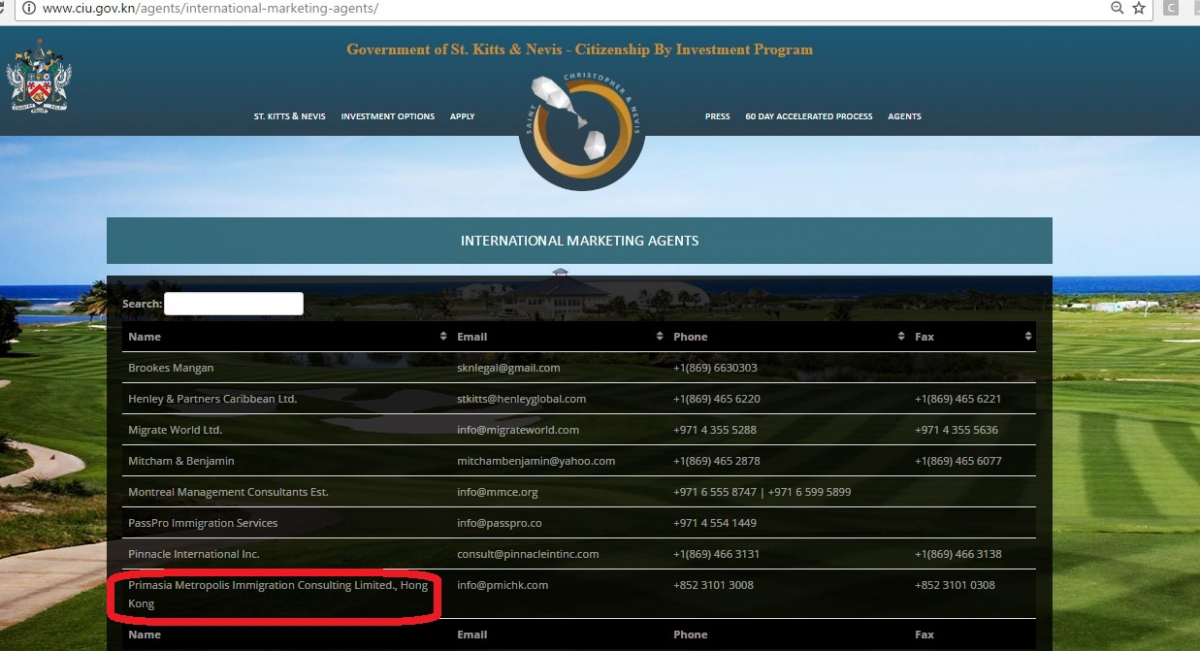
首都投資移民顧問有限公司現已成為聖基茨及尼維斯公民投資申請的8個國際營銷代理商之一。
Link: http://www.ciu.gov.kn/agents/international-marketing-agents/